News

Yasu Sudo from UCL visits XPrag.de at ZAS in Berlin

On December 17th, he presented joint work with Benjamin Spector on “Presupposed ignorance and exhaustification: or how scalar implicatures and presuppositions interact”.

Abstract:
We investigate interactions between scalar inferences and presuppositions. There are two major observations to be accounted for: (i) Scalar items in Strawson decreasing environments give rise to scalar inferences only in the presupposition, as observed previously by Gajewski & Sharvit (2011); (ii) Scalar items that generate ignorance inferences give rise to what we call presupposed ignorance inferences in presuppositional contexts. To give a uniform account of these observations, we postulate the “Presupposed Ignorance Principle”. However, this alone makes wrong predictions for non-Strawson decreasing environments. In order to circumvent this problem, we postulate a scalar strengthening mechanism responsible for scalar implicatures, which crucially is a presupposition hole (just like ‘only’).

WP_20141217_004_small

Application deadline for SIAS Summer Institute Fellowships approaching

The SIAS Summer Institute “The Investigation of Linguistic Meaning: In the Armchair, in the Field, and in the Lab” offers fellowships for early-career researchers.
The deadline is January, 6th 2015. Application details can be found here!

About the program
The SIAS Summer Institutes are two-year research programs for young researchers and treat interdisciplinary topics. The goal of the Institutes is to sponsor joint interdisciplinary work by European and American researchers at an early stage of their career, thus fostering research networks and common activities. The idea is that cohort formation will, in the long run, contribute to close ties between research activities in Europe and the U.S. while simultaneously supporting the development of new fields of research.
Every Summer Institute consists of two 10– to 14–day workshops held in consecutive years, alternating between Europe and the United States. A team of one European and one American researcher heads the Summer Institute, in which these two Conveners and 20 Fellows — generally 10 Europeans and 10 Americans — as well as two to four outside specialists take part. Doctoral candidates near completion of their dissertation and post-docs may apply. Post-docs’ doctorates should have been completed no more than five years earlier, and their research work should have addressed one of the topics proposed for the institute. Participants receive a small stipend; travel and lodging costs are covered by the program. Accepting the fellowship commits the researcher to taking part in both workshops.

Talk of XPrag.de member Nicole Gotzner in Utrecht

On Dec 10th XPrag.de member Nicole Gotzner of project SIGames at ZAS Berlin will give a talk on “Exhaustivity and models of implicature computation” at Utrecht University. Details can be found here!

Abstract:

A sentence like ROB came to the meeting may give rise to the inference that no other person came to the meeting. Whether or not such an exhaustivity inference arises depends on the information structure and intonational realization of the sentence (e.g., Rooth, 1992; Pierehumbert & Hirschberg, 1990). In this talk, I will address the question how psycholinguistic experiments may adjudicate between different theoretical proposals concerning the mechanisms underlying the derivation of exhaustivity inferences.
The psycholinguistic literature in this area has to a large extent focused on scalar implicatures triggered by the quantifier some. One much discussed phenomenon is that the computation of implicatures incurs a processing cost, however, it is currently unclear what this processing cost is due to (see for example Chemla & Singh, 2014 for an overview). Moreover, the relationship between focus, exhaustivity and implicatures has been neglected in many previous studies (though see for example Zondervan, 2010 and Tomlinson & Bott, 2013).
I will present a series of studies comparing exhaustivity inferences triggered by the focus particle only and contrastive pitch accents. The results indicate that contrastive prosody is as effective in conveying an exhaustive inference like the focus particle only. This inference is derived quickest when the referent noun is preceded by only (e.g., Only Rob came to the meeting), intermediate when the referent is realized with a contrastive pitch accent (L+H*) and slowest with neutral realization (H*). These data can be explained under the following assumptions: (i) exhaustivity inferences come about via a silent only operator (e.g., van Rooij & Schulz, 2004); (ii) the application this operator incurs a processing cost, possibly because listeners need to decide among alternative readings of the sentence (see also Marty & Chemla, 2013) and (iii) contrastive prosody facilitates this decision process.

References
Pierrehumbert, J. & Hirschberg, J. (1990). The meaning of intonational contours in the interpretation of discourse. In P. Cohen, J. Morgan & M. Pollack, eds., Intentions in Communication, 271-311, Cambridge, MA: MIT Press.
Marty, P. P., & Chemla, E. (2013). Scalar implicatures: working memory and a comparison with only. Frontiers in psychology, 4.
Tomlinson, J. & Bott, L. (2013). How intonation contrains pragmatic inference. In Markus Knauff, Michael Pauen, Natalie Sebanz & Ipke Wachsmuth (eds.), Proceedings of the 35th Annual Conference of the Cognitive Science Society, 3569 – 3575.
van Rooij, R. & Schulz, K. (2004). Exhaustive interpretation of complex sentences. Journal of Logic, Language, and Information, 13, 491-519.
Zondervan, A. (2010). Scalar implicatures or focus: An experimental approach. LOT Dissertation Series 249, Utrecht.

Lecture of XPrag.de member Gerhard Jäger at ‘Treffpunkt Sprache’

On December, 9th XPrag.de member Gerhard Jäger from project ProComPrag at Tübingen University will hold a lecture at ‘Treffpunkt Sprache’.
‘Treffpunkt Sprache’ is a joint lecture series of the Center for General Linguistics (ZAS) Berlin, the Department of German Studies and Linguistics and the Department of Philosophy at Humboldt-University.

Venue: Dorotheenstraße 24, 10117 Berlin, Raum 1.101
Time: 19:00 Uhr

Abstract:
Schon Charles Darwin bemerkte, dass zwischen biologischer Evolution und Sprachwandel auffällige Parallelen existieren. Neue Arten und neue Sprachen entstehen, indem sich eine Population in mehrere Teile aufspaltet, die sich getrennt voneinander weiterentwickeln. Mithilfe der komparativen Methode können diese Prozesse teilweise rekonstruiert werden.
In den letzten dreißig Jahren wurden in der Bioinformatik eine Vielzahl von Algorithmen entwickelt, die es ermöglichen, die komparative Methode zu automatisieren und die Evolutionsgeschichte von Organismen zu rekonstruieren. Neuerdings werden diese Techniken verstärkt auch zur Untersuchung der Sprachgeschichte angewendet. In dem Vortrag werden aktuelle Entwicklungen und Herausforderungen dieses neuen Feldes der computergestützten historischen Linguistik vorgestellt.

XPrag.de member Nicole Gotzner gives opening talk of a new event series at ZAS

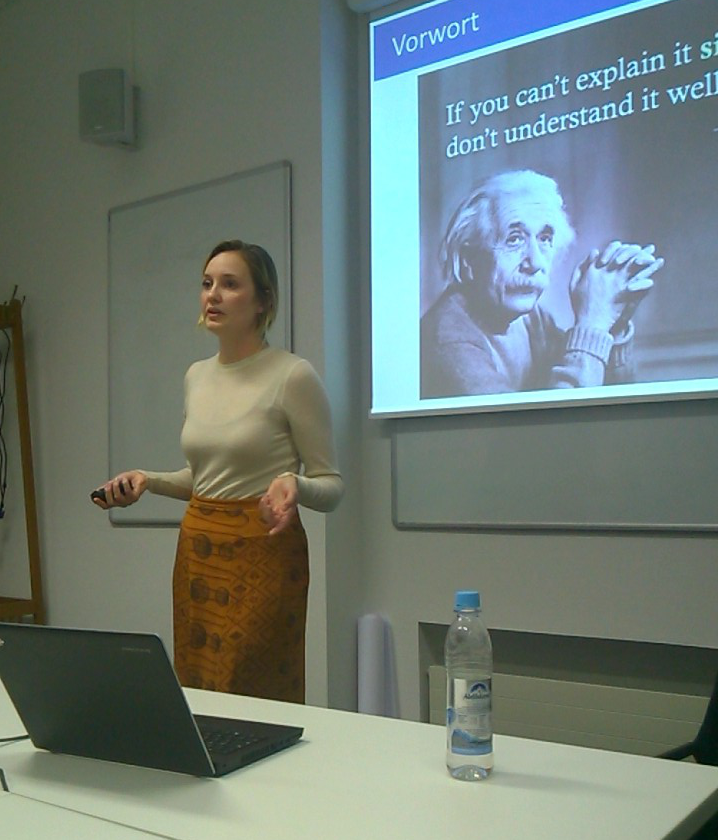
On December, 3rd 2014, XPrag.de member Nicole Gotzner gave the opening talk of a new event series organized by XPrag.de associate Carla Umbach for the Center for the General Linguistics (ZAS) and the Center for Literary and Cultural Research (ZFL) Berlin.
PhD candidates from ZAS and ZFL will meet regularly presenting their PhD-projects in a mutually intelligible way. It is a well-known fact that explaining ideas to an uninformed audience helps to bring a PhD thesis a big step forward. In return, the candidates will get feedback of non-experts that might broaden their own perspective.
Nicole was the ideal candidate to open the series: She has submitted her thesis but has not defended it yet – so she could share recent experiences. Following the maxim of Albert Einstein “If you can’t explain it simply, you don’t understand it well enough” Nicole presented her thesis very tangibly so that finally everybody got involved in the vivid follow-up discussion.
She definitely brought the series on the right track.

XPrag.de member Bettina Braun co-organizes DGfS-Workshop “The prosody and meaning of (non-)canonical questions across languages”

XPrag.de member Bettina Braun from project BiasQ: Bias in Polar Questions and associated colleagues are organizing the workshop "The prosody and meaning of (non-)canonical questions across languages". The workshop is organized as part of the Annual Conference of the German Linguistic Society (DGfS) to be held in Leipzig, Germany, March 4-6, 2015 (DGfS Meeting 2015)

Organizers:
Daniela Wochner, Nicole Dehé, Bettina Braun (U Konstanz) & Beste Kamali, Hubert Truckenbrodt (ZAS Berlin)

Invited speaker:
Sigrid Beck (University of Tübingen) & Nancy Hedberg (Simon Fraser University)

Abstract:
There has been a recent spur of research aiming to understand interrogatives from multiple perspectives including prosody, semantics, and pragmatics. In bringing together research on canonical and non-canonical questions, we aim to provide a forum where cutting edge theoretical approaches meet highly detailed empirical assessment.

For canonical questions, the workshop is particularly interested in the relation between questions and focus in the different modules of grammar, and in the role of the intonation contour in different questioning types. Where do questions show question-specific stress- or phrasing patterns? Where do wh-phrases show similarities to focused phrases? Why do the alternatives in alternative questions show focus prosody? Intervention effects are an important topic in the interaction between focus and wh-phrases and/or alternatives in alternative questions. Are there other interactions as well? What question-specific intonation contours or question-specific assignment of intonation contours do different languages show, and how is the variation to be understood?

The non-canonical questions that the workshop is interested in include those which (i) besides being used as requests for information, have further pragmatic dimensions; (ii) have non-interrogative syntax; and/or (iii) may be identified as non-canonical through their prosody, or any combination of these properties. Example types are declarative questions, tag questions, and rhetorical questions. We would like to see if various well-known –but not uncontroversial- properties of non-canonical questions stand up to closer scrutiny: Are declarative questions and tags always confirmation-seeking rather than information-seeking? Do declarative questions always have rising intonation and why? How to approach the illocutionary force of assertion in rhetorical questions and to what extent can their prosody inform us? How do modal particles such as schon in German contribute to the rhetorical question pragmatics?

This workshop is of interest to a broad audience working on syntax, semantics, prosody, and their interfaces, with a focus on interrogatives and related phenomena.

Workshop: “Experimental Methodology in Semantics and Pragmatics” at Sinn und Bedeutung 20

XPrag.de members Oliver Bott and Sonja Tiemann are organizing together with Robin Hörnig and Janina Radó (Uni Tübingen) the workshop “Experimental Methodology in Semantics and Pragmatics” at Sinn und Bedeutung 20 to take place at University of Tübingen on Wednesday, September 9, 2015. The deadline for submissions is February 15th 2015.

Call for Papers:
The number of researchers in semantics and pragmatics using experiments as a tool to evaluate hypotheses derived from linguistic theories is increasing. This workshop offers a forum for methodological reflection on what can and cannot be achieved with experimental work in our field and which paradigms are best suited to yield reliable and valid results for answering current questions in semantics and pragmatics.
We invite contributions addressing one or more of the following topics:

1. Method Evaluation
1.1 Comparing experimental methods:
What are the advantages and limitations of existing psycholinguistic methods? How can these methods be combined and extended for the purpose of investigating questions in semantics and pragmatics? How can the current methodological repertoire be extended by adapting and developing new techniques?
1.2 Experimentation vs. other methods:
What are the advantages of corpus studies, field work, and computational modelling compared to experimental methods? How can these other methods complement experimental evidence?
1.3 Basis and Limits of Speaker Judgments

2. Implications of Experimental Results for Semantic and Pragmatic Theorizing
2.1 Does the predicted effect reflect the structure under investigation or some processing constraint?
2.2 (How) can we supplement formal theories with (independent) processing components?
2.3 What linking hypotheses are necessary to relate experimental data to semantic/pragmatic theory?
2.4 How can experimental results contribute to a reassessment of central theoretical concepts?

3. Problematic Data
3.1 How can we deal with conflicting evidence?
3.2 What do null effects tell us?

We invite submissions for 20-minute talks plus 10 minutes for discussion. Abstracts must be anonymous, in PDF format, 2 pages (A4 or
letter), in a font size no less then 12pt, and with margins of 1 inch/2.5cm. Please submit abstracts via EasyChair (see link below) no later than February 15th 2015.
Abstracts should be submitted via EasyChair, using the following link: submissions
For questions or enquiries please write to: sub20xmeth@gmail.com